Domino's reports fiscal Q3 before the open on Tuesday, October 13, and it comes into the print under pressure. Yahoo Finance coverage says the Q2 report missed sales and profit estimates for the second quarter in a row. The shares reportedly fell 11% after the sales miss, and the company cut its US same-store sales outlook to low single digits from roughly 3%. Previews call the revised Best Deal Ever promotion, which now includes Stuffed Crust, the swing factor for the quarter.
I don't have a view on the promotion. What I can look at is the physical footprint. I wanted to answer two questions. How exposed is Domino's to Pizza Hut and Papa John's where it actually delivers? And how much room is left to grow by adding stores, rather than by selling more out of the ones it already has?
Who else is in the delivery zone
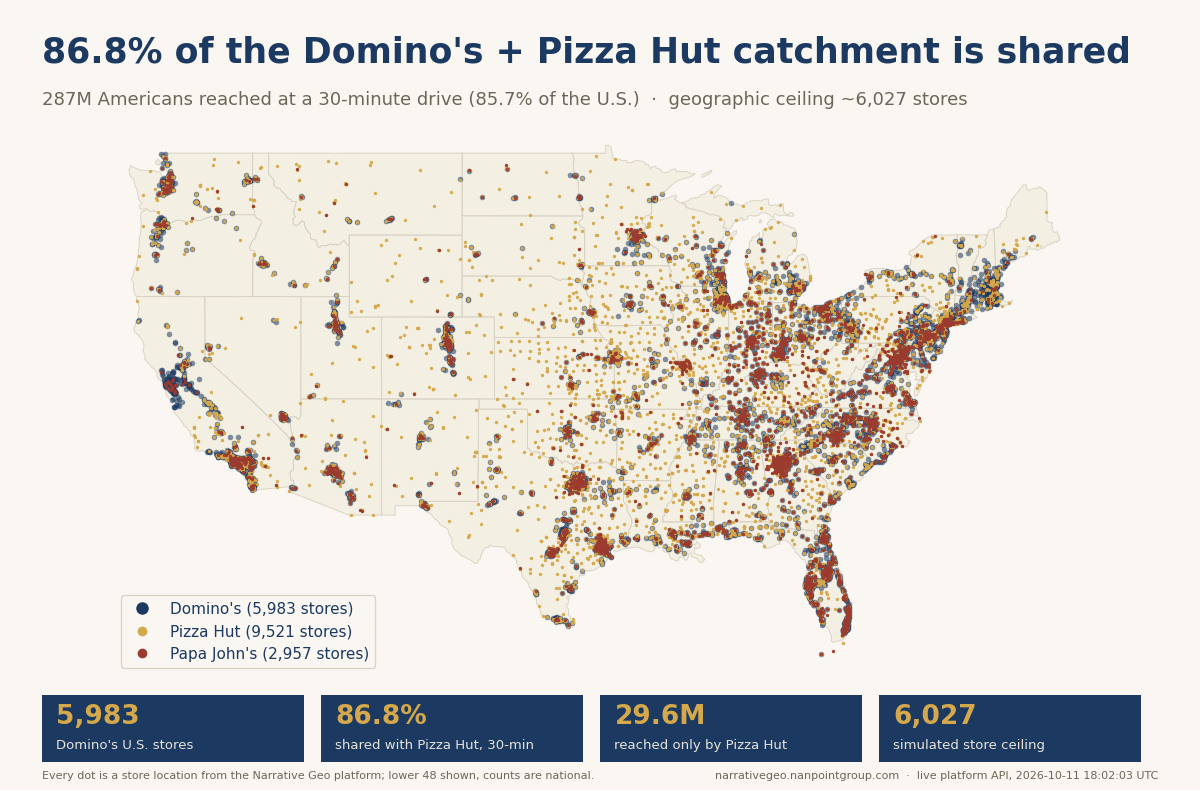
Our store list has 5,983 Domino's locations. Within a 30-minute drive they reach 85.74% of the US population. Pizza Hut, with 9,521 stores, reaches 90.91%. Papa John's, with 2,957 stores, reaches 81.19%.
At 30 minutes the overlap is close to total. 95.7% of the people within reach of a Domino's can also reach a Pizza Hut. For Papa John's the figure is 89.7%. At that distance every chain is everywhere, and the comparison says very little.
Thirty minutes is a long way for a pizza, though. Delivery happens at the short end of the curve, so I ran the overlap at tighter drive times. At 10 minutes, Pizza Hut covers 87.3% of Domino's reachable population and Papa John's covers 70.3%. At 5 minutes, Pizza Hut still covers 65.1%. Papa John's drops to 39.4%.
That was the part that surprised me. On paper Papa John's is a national competitor. At the drive times that matter for delivery, a large share of Domino's customers don't have one close by. Pizza Hut is the competitor inside the zone.
From the other side it reads differently. At 5 minutes, 67.8% of Papa John's reachable population also has a Domino's nearby. Papa John's is more exposed to Domino's than Domino's is to Papa John's.
If the Q3 debate is about value and promotion, the competitors that matter at close range are mostly Pizza Hut stores. A Papa John's deal matters less to much of the Domino's customer base, because there often isn't a Papa John's around the corner.
How much map is left
The second question is runway. At the 30-minute preset, our saturation model puts a ceiling of 6,027 stores on the Domino's network. The current footprint sits at 99.3% of that ceiling, with 44 incremental stores identified.
The store-level numbers point the same way. The median Domino's store has 571,920 people within 30 minutes, but those catchments overlap heavily. Across the population the network reaches, that works out to one store for every 48,011 people. 1,732 stores sit in thinner catchments at the low end of the distribution.
The whitespace screen finds 60 candidate locations, covering 1,732,863 people between them. The top site is Arnold, in the St. Louis metro, with a score of 0.724 and 22,269 people. The St. Louis metro takes most of the top of the list: Arnold, Wentzville, House Springs, Shiloh and O'Fallon. Rogers in northwest Arkansas, New Windsor and Middletown fill out the rest.
These are suburban fill-ins, not new territory. A few dozen stores in places like Wentzville won't move a national same-store sales number. For Domino's in the US, growth comes mostly from the kitchens it already has.
What I'll be listening for
Two things. First, whether management describes competitive pressure in a way that lines up with the map. The map points at Pizza Hut far more than Papa John's. Second, whether US unit growth plans sound like infill or like new markets. The footprint suggests there aren't many new markets left to find.
The exhibit pack has the overlap curves, the saturation output and the full whitespace list. Anyone who wants it before the call can have it.