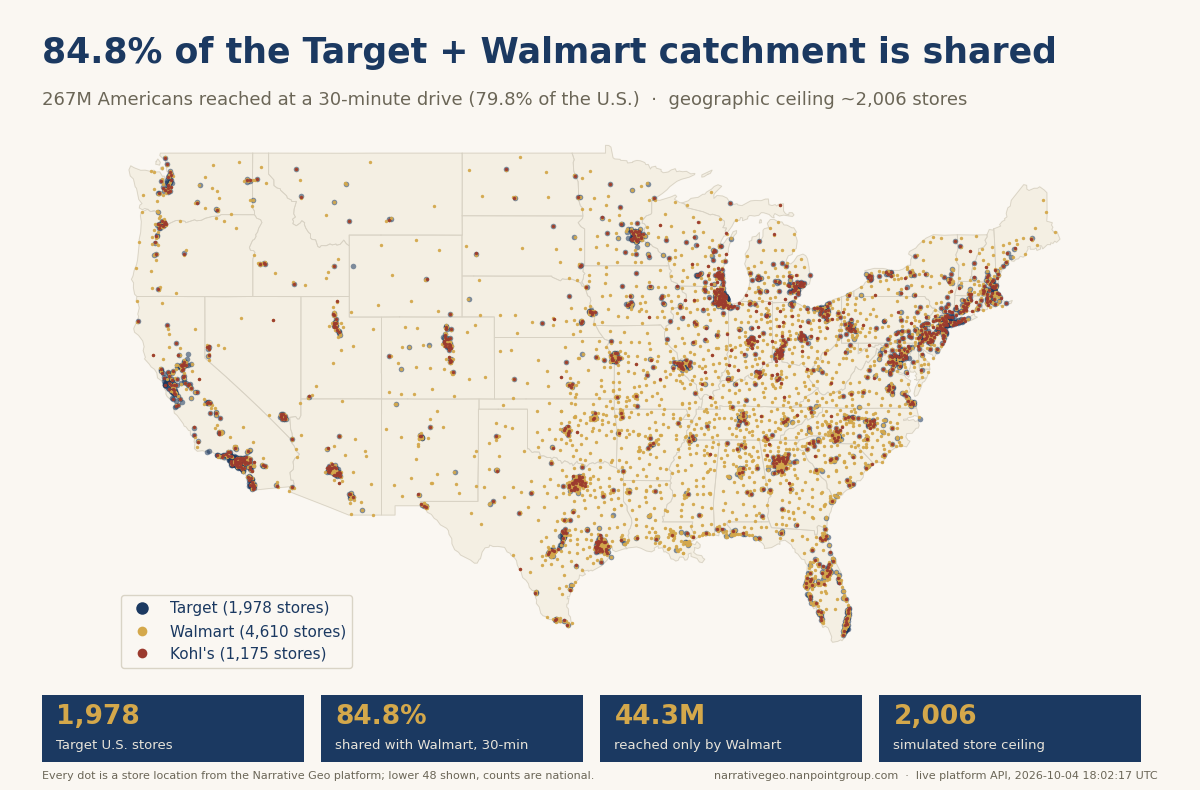
HSBC upgraded Target from Hold to Buy this week. The reported reason was visits. Comparable sales rose 3.8% last quarter, and HSBC said the growth came from customer visits rather than price increases. Target is also reported to be opening eight new stores this fall, which brings its openings this year to 32. Newsweek reported capex of about $5 billion for the year under new CEO Michael Fiddelke.
A traffic-led turnaround and an opening program are two different bets. The first is about getting existing shoppers to come back more often. The second is about reaching people Target does not reach today. I wanted to see what the map says about the second one.
Where Target already reaches
Target runs 1,978 stores in our data. Within a 30-minute drive, those stores reach 267,484,232 people, or 79.84% of the US population. Average household income across that reach is $97,937.
The spread between stores is wide. The median Target has 893,063 people within 30 minutes. The tenth-percentile store has 160,954. The ninetieth-percentile store has 3,017,664. That is a chain that already covers the dense places and a long tail of smaller ones.
Almost every Target is a Walmart neighbour
Walmart has 4,610 stores and reaches 308,821,865 people at the same 30 minutes. The overlap is the part I keep coming back to. Of the people Target reaches, 98.9% also live within 30 minutes of a Walmart. The number of people inside Target's reach and outside Walmart's is 2,970,256.
Drive time changes the picture, but less than I expected. At 5 minutes, 33.9% of Target's reach overlaps Walmart's. At 10 minutes it is 73.6%. At 15 minutes it is 88.6%. The short convenience trip is the only place where Target still has some ground of its own, and even that is shared with a Walmart about a third of the time.
Kohl's is a different kind of overlap. Its 1,175 stores sit almost entirely inside Target's footprint. At 30 minutes, 97.1% of the people Kohl's reaches are also within reach of a Target, and the two chains overlap at 93.19% overall. For anyone watching apparel and home share move between the two, that is the same customer base.
So when HSBC credits visits for the comp, the map adds context. Those visits are not coming from new territory. They are coming from households that also have a Walmart nearby, and in most cases a Kohl's.
How much room is left
The opening plan is the part I find hardest to square with the footprint. Our whitespace screen finds 29 candidate markets with 697,657 people in them combined. The top-ranked market is Hinesville, with 20,703 people in reach and an average income of $60,828, well below the chain's average. After it come Slidell, Ridgecrest, Columbus, Pocatello, Findlay, Middletown and Enid. Small towns, mostly outside large metros.
The saturation model is blunter. It puts Target's ceiling at 2,006 stores and flags 28 incremental sites. On that measure the chain sits at 98.6% of its ceiling.
That does not mean the opening plan is wrong. Our model counts people within a drive time. It does not see store formats, remodels, capacity relief for crowded stores, or fulfilment. A new Target in an existing trade area can still make sense for those reasons. But it does mean the payoff from new stores has to come from taking share inside trade areas Target already touches, mostly from Walmart, rather than from reaching new households.
That is what I will be listening for when Target next reports. Is management describing new stores as reach, or as share? The footprint says it has to be the second.
The exhibit pack behind this piece has the Walmart and Kohl's overlap maps, the drive-time curve and the whitespace list. It is free to anyone who wants it, and the only ask is attribution to Narrative Geo if you cite it.