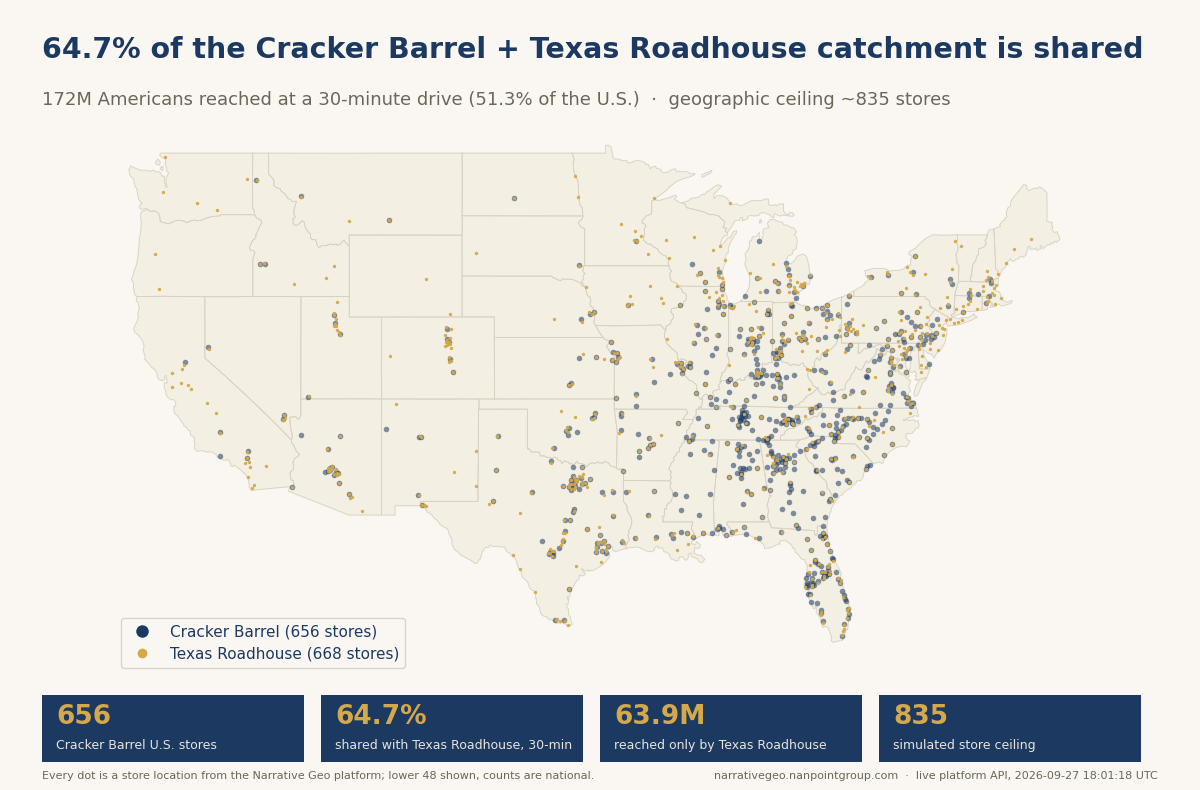
Cracker Barrel's first quarterly report under new CEO David Deno went over well with the market. Quartz reported that the stock rose 8.3% after adjusted EPS of $0.99 came in against a $0.26 consensus. The same report said comparable store restaurant sales fell 2.1% and revenue slipped 2.2%.
The line I kept coming back to was somewhere else. Restaurant Business reported that guidance for next fiscal year calls for 3% to 5% comparable-store restaurant sales growth and no new store openings. FSR Magazine reported that further remodels are paused while the company evaluates store data.
Put those together and the question gets simple. With no new units and no remodel program, the comp recovery has to come from the existing boxes. So which boxes are they, and who lives near them?
What the existing footprint reaches
We count 656 Cracker Barrel locations. Within a 30-minute drive they reach 51.3% of the US population. The median age across that reach is 38.
The spread matters more for a turnaround than the total does. 261 stores reach fewer than a quarter of a million people within 30 minutes. These are the interstate and small-town boxes that built the brand. They depend on travelers and a thin local base. A traffic-led recovery has to work in these stores as well as in the suburban ones, and the levers are different. A menu or price change shows up quickly in a dense trade area. In a thin one, results depend on who is driving past.
Texas Roadhouse sits in the same regions, not the same lots
Texas Roadhouse is the obvious comparison. We count 668 locations, so the two chains are almost the same size. Texas Roadhouse reaches 64.6% of the US population within 30 minutes.
At a 30-minute drive, 88.8% of the people Cracker Barrel reaches can also reach a Texas Roadhouse. That is close to full regional overlap. The picture changes as the radius tightens. At 15 minutes the shared share is 64.2%. At 10 minutes it is 43.7%. At five minutes it drops to 18.7%.
I did not expect it to fall off that steeply. The two chains cover the same states and many of the same metros, but they rarely share a corner. Cracker Barrel built at the interstate exit. Texas Roadhouse built on the suburban retail pad. For a family choosing where to eat on a Friday night, the competitor is usually a short drive away but not across the parking lot. For a traveler at an exit, it is often not in the picture at all.
That split helps with reading the next few quarters. If the recovery shows up first in stores where the two chains are closest, Cracker Barrel is probably winning a direct fight on value and experience. If it shows up first in the thin highway stores, travel and brand are more likely doing the work.
The headroom that is now parked
Our saturation model puts a ceiling of 835 stores on the Cracker Barrel format, which leaves 179 incremental locations. The chain sits at 78.6% of that ceiling. The whitespace screen finds 60 candidate markets, led by Port Orchard, Green Bay and Puyallup, with several of the top names in Washington.
None of that is in play next year. The guidance takes unit growth off the table. I think that is the right call for a turnaround that needs the base working first. It does mean the whitespace is an option, not a plan. For now the investment case rests on same-store performance across 656 existing boxes, with the mix of dense and thin trade areas described above.
The remodel pause is the part I would watch most closely. Management says it is evaluating store data. A footprint map is one version of that data. It shows which boxes have a large local population, which depend on the highway, and which face a Texas Roadhouse a short drive away.
The exhibit pack has the store maps, the drive-time overlap table against Texas Roadhouse and the whitespace list. If you want it, get in touch and I will send it.