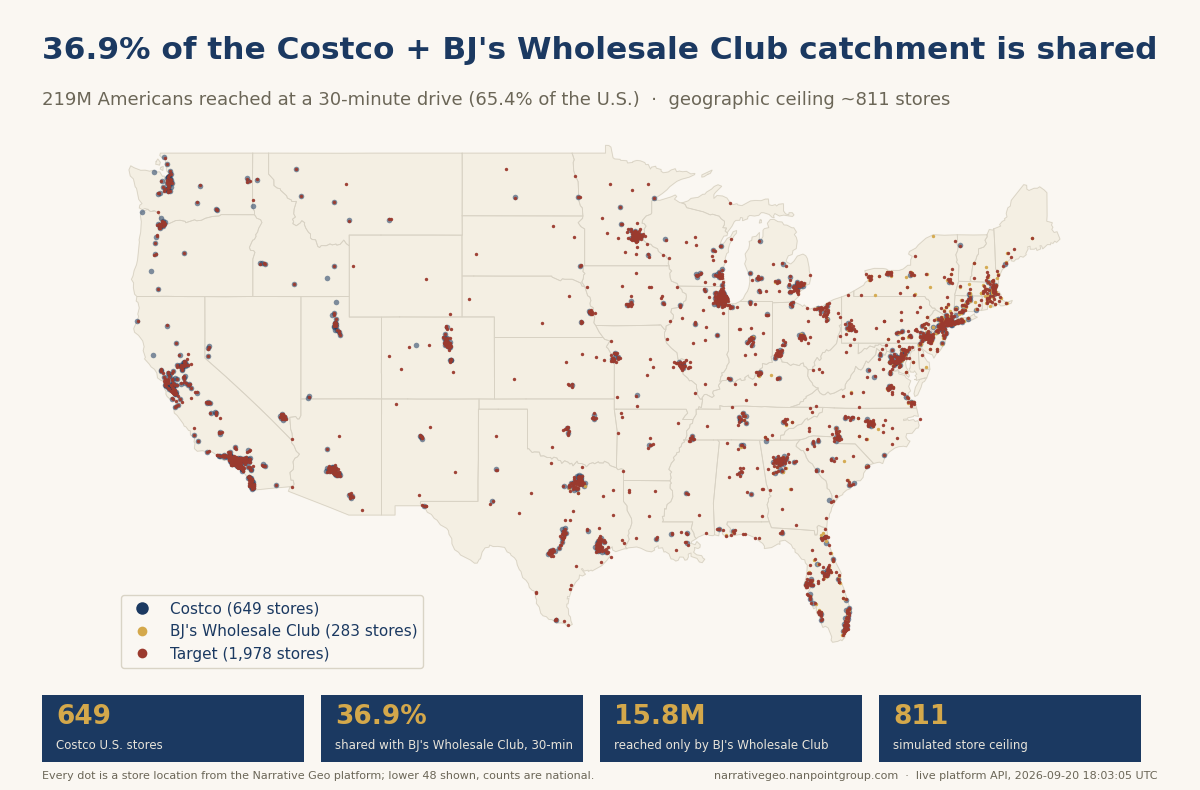
Costco confirmed it will open 14 new warehouses across the U.S. and Canada by year-end, five in October and nine in November, with the October wave reported in Lee's Summit MO, The Colony TX, Amherst NY, Lawrence KS and Camarillo CA. The company closes fiscal 2026 on September 24. It is one of the few large reports on an otherwise quiet week.
That combination is what made me open the map. A confirmed opening list is a rare thing to hold against a saturation model, because you get to check the model against what the company actually decided to do with its own capital.
What the footprint looks like today
We run 649 Costco locations at a 30-minute drive time on H3 resolution 7. Those trade areas reach 219,102,199 people, 65.4% of a U.S. population of 335,025,774. Average household income inside the footprint is $101,650, against a national profile that is meaningfully lower. Total wallet in range is $22,244,593,446,588. Median age is 37.9 and working-age population is 135,993,320.
The education skew is the part buy-side people tend to underweight. Inside the Costco footprint, 23.8% hold a bachelor's degree and 15.8% hold a master's or above. Daytime population is 226,264,891 against 95,184,052 total jobs, of which 9,567,322 are retail. This is a footprint pointed at educated, employed, higher-income households, and it has been for a long time.
Coverage per store is uneven, which matters for how you read a new opening. The median Costco trade area holds 974,257 people. The tenth percentile holds 252,508 and the ninetieth holds 2,573,977. The largest single trade area holds 9,200,398. Sixty-five stores sit under 250,000 people in range. Average population per store is 337,600.
The saturation question
Our ceiling model puts the U.S. Costco network at 811 locations. That is 162 more than the 649 standing today, and it means the chain is at 80.0% of ceiling. The candidate pool behind that number is 388 markets, of which 180 fall below the 30% threshold the model uses.
So 14 new warehouses is not a small number against 162 of remaining theoretical room. The question for anyone modelling the next several years is not whether Costco can keep opening. It is what each incremental opening earns once the obvious markets are gone, and how much of the new volume is transfer from a club twenty minutes down the road.
The tighter whitespace screen returns 60 candidate markets holding 1,411,300 people in total. The top of the list: Methuen in Boston-Cambridge-Newton at a 0.823 score and $123,281 average income, Spring Hill in Tampa-St. Petersburg-Clearwater also at 0.823, Bonaire in Warner Robins at 0.820, Lakeland at 0.817, and Deltona at 0.808. Williamsville in Buffalo-Cheektowaga scores 0.806, alongside Kannapolis in the Charlotte metro. Palm Bay rounds out the top of the screen at 0.805. Florida shows up four times in eight.
Overlap depends entirely on how far you are willing to drive
The headline overlap numbers are almost useless on their own. At a 30-minute drive time, 99.2% of Costco's reached population also sits inside a Target trade area, and 81.5% of Target's sits inside Costco's. Target runs 1,978 locations reaching 266,705,687 people, 79.61% of the country. At 30 minutes, almost everyone is near almost everything.
Narrow the radius and the picture separates. At 15 minutes, Target's overlap with Costco's population falls to 96.0%. At 10 minutes it falls to 85.2%, and at 5 minutes to 44.2%. Against BJ's the decay is steeper: 84.6% of BJ's population sits inside a Costco 30-minute area, 60.1% at 15 minutes, 33.2% at 10 minutes and 6.9% at 5 minutes. BJ's runs 283 locations reaching 102,440,372 people, 30.58% of the U.S., which puts the Costco store ratio at 2.29 to one.
What that decay curve tells you is where the genuinely contested trips are. A 30-minute overlap figure describes the map. A 5- or 10-minute figure describes a shopping decision. When 36.9% of the two-chain union overlaps at 30 minutes but only 2.1% overlaps at 5 minutes, the fight for convenience trips is far narrower than the regional map implies.
I put the maps, the decay curves and the full 60-market candidate list into an exhibit pack. It is citation-ready and available on request if it is useful before the print.