On Sept 10, Brian Niccol said the Starbucks turnaround was complete and that the next priority is renovating thousands of cafes. CNBC reported that more than 1,000 locations were renovated over the past nine months, with more than 1,500 expected by fiscal year-end and thousands more planned next fiscal year. The company reported comparable store sales up 7.9% in its fiscal third quarter, and the shares rose after the renovation plans were outlined.
When I covered US consumer on the buy side, capex announcements like this always raised the same question. Which stores? Renovation money is a bet on which existing boxes matter most. That is a footprint question, so I pulled the map.
A footprint at its ceiling
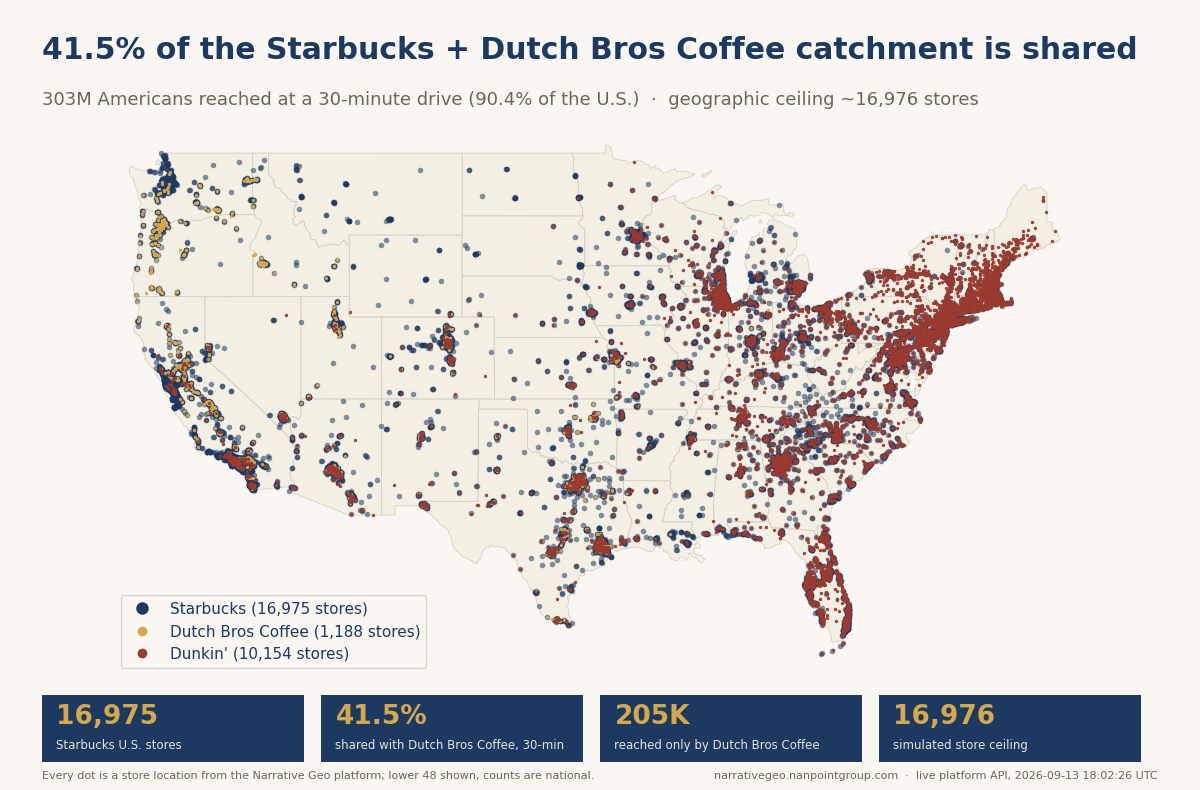
Starbucks runs 16,975 US stores by our count. Within a 30-minute drive they reach 302,889,374 people, or 90.41% of the country. The median store has 866,624 people inside its 30-minute trade area. The bottom tenth sit at 118,374 or fewer.
Our saturation model looks for places where a new store would add meaningful reach. It found one. The single whitespace candidate covers 20,830 people. By that measure the network is at its ceiling.
That was the first thing that stood out. When a chain cannot grow its reach by opening stores, the growth has to come from the stores it already has. Seen from the map, the pivot to renovation looks less like a choice and more like the main lever left in the physical network. That is my reading. The company did not frame it that way.
Dutch Bros is building on Starbucks ground
Dutch Bros has 1,188 stores. Starbucks has 14.29 for every one of them. On size alone this is not a fair fight. The overlap tells a different story.
Of the people Dutch Bros reaches within 30 minutes, 99.8% are also within 30 minutes of a Starbucks. Tighten the drive time to the closest ring we measure and it is still 86.6%. At 30 minutes, Dutch Bros reaches only 205,095 people that Starbucks does not. Almost every Dutch Bros customer lives near a Starbucks.
From the other side, 14.3% of Starbucks' closest-in population is also close to a Dutch Bros. That is a minority of the network. But it is a specific minority, and you can map it. It is where a drive-thru competitor is chasing the same morning trip a short drive away.
For a renovation program, that argues for a targeted list. In those shared trade areas, a tired cafe has a direct alternative close by. A refreshed store there probably does more work than the same spend in a trade area with no nearby rival.
Dunkin' is the broad fight
Dunkin' has 10,154 stores and a very different overlap. At 30 minutes, 88.9% of the people Starbucks reaches are also reached by Dunkin'. Going the other way, 97.7% of Dunkin's reach is shared with Starbucks. Even at the closest ring, 50.4% of Starbucks' population overlaps with Dunkin'.
This is not a pocket. It is most of the country. Dunkin' sells mostly on speed and value rather than on the room, so a new interior does less against it head on. The Dunkin' overlap probably matters more for how renovated stores are run, meaning throughput, mobile order and the drive-thru, than for which stores get picked first.
Put the two comparisons together and the map suggests a sequence. Dutch Bros tells you where to renovate first. Dunkin' tells you what the renovated store has to be good at.
When Starbucks next reports, the number of cafes renovated is the less interesting disclosure. The more useful one is where they are. If the program skews toward trade areas it shares with Dutch Bros, it is a defence program. If it tracks store volume alone, some of the most contested stores may still be waiting.
The maps and overlap tables behind this piece are in an exhibit pack. If you would like a copy, get in touch and I will send it.