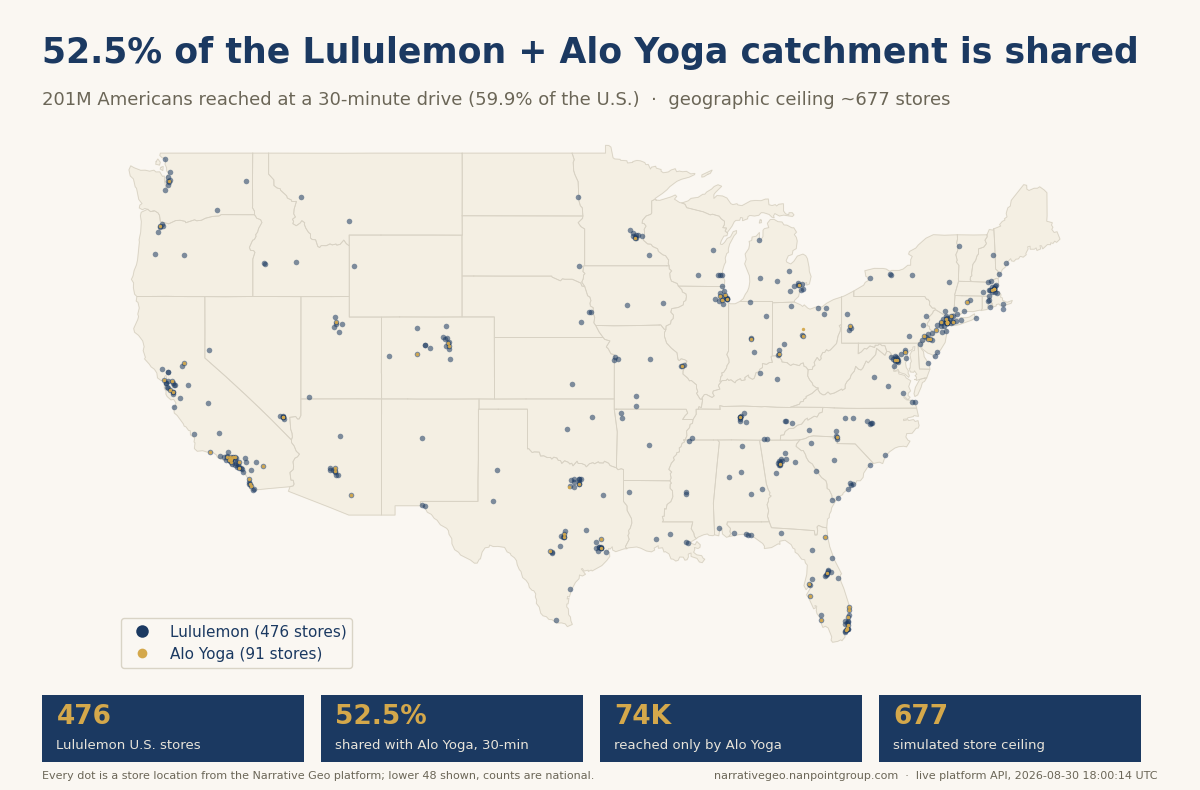
Lululemon printed today. This is not a note about the quarter. I do not have the actuals in front of me and I would not add much if I did.
What I do have is the footprint work, which went out before the print and has not been touched since. That is the point of publishing it early. It cannot be bent to fit whatever was said on the call.
Here is what it said.
Lululemon operates 476 stores in the US. Draw a 30 minute drive around every one of them and you reach 200,701,073 people, or 59.91 percent of the country. Average household income inside that reach is $102,277. Median age is 37.9. Working age population is 125,164,197. Total wallet inside the footprint is $20,501,587,263,004. That is a well-placed fleet against a population of 335,025,774.
The more useful number is what is left. Run the saturation model and the ceiling comes out at 677 stores, which leaves 201 to build. The fleet is at 70.3 percent of that ceiling. The candidate pool is 576 and 280 of those sit below the 30 percent threshold. That is not a company out of room. It is a company past the easy part of the runway.
The distribution matters more than the average. Median store trade area population is 1,139,260. The tenth percentile is 209,561. The ninetieth is 3,273,390. The largest single store trade area holds 10,037,773 people. Fifty-six stores sit under 250,000. Population per store across the fleet is 421,641. A fleet where the tail is that thin and the head is that heavy does not respond uniformly to anything, good or bad.
The whitespace screen returned 60 candidate markets holding 1,437,749 people. The top score is 0.847, in Port Orchard, Washington, population 21,843, average income $90,917. Riverview in Tampa scores 0.843. Chesterfield outside Richmond scores 0.842. These are not flagship markets. They are the mid-size, mid-income places a maturing fleet fills in.
Then Alo Yoga, which is the comparison people asked for. Alo runs 91 stores to Lululemon's 476, a ratio of 5.23. Alo reaches 105,386,194 people, 31.46 percent of the US. At a 30 minute drive, 99.9 percent of Alo's reach already falls inside Lululemon's. Only 74,484 people are reachable by Alo and not by Lululemon. Tighten the ring to five minutes and the overlap drops to 27.1 percent of Lululemon's reach but stays at 91.7 percent of Alo's. Alo is not opening new geography. It is opening across the street.
Hold all of that against what you heard today. Where the map and the commentary agree, fine. Where they disagree is where the work is.
Next on the calendar is TJX on November 19, followed by Walmart on November 20. Dick's Sporting Goods and Kohl's both print on November 25, and Dollar Tree on December 3. The same footprint work goes out ahead of each one.