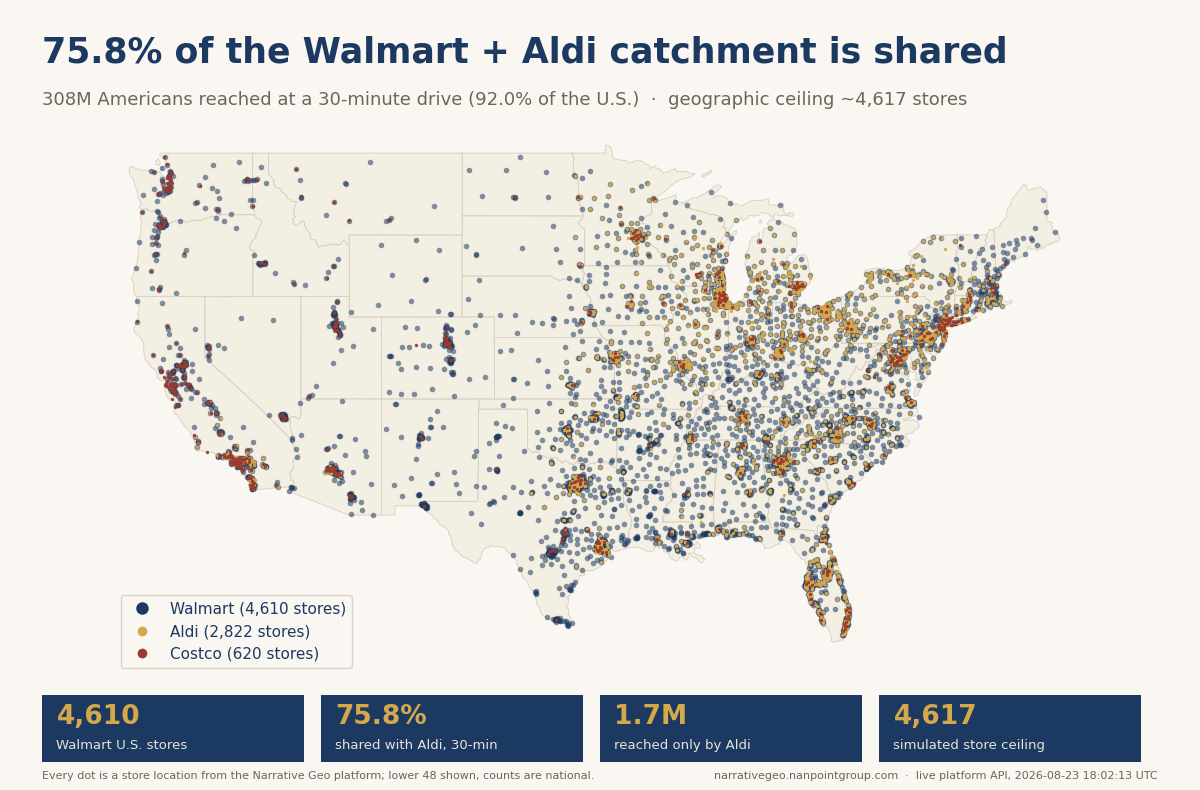
Walmart was chosen for this week's work off the news, not off the calendar. Shares fell about 9% on Thursday, August 20, their worst single-day drop in more than four years, erasing over $80 billion in market value, per CNBC. Reporting put US comparable sales up 2.6% ex-fuel, short of consensus and the slowest pace in more than six years, with transactions up 1.5% and ticket up 1.1%. Grocery Dive, citing Numerator, reported that Costco, Amazon and Walmart each took US grocery share over the past year while major supermarket companies lost it.
Those are reported figures. What follows is ours.
We published the footprint work before this print. Nothing below has changed since. The point of putting it out in advance was to have a fixed reference to hold against the call, not to forecast the quarter, and we are not going to relitigate the quarter here.
What the map said
Walmart's 4,610 US stores reach 308,102,959 people inside a 30-minute drive. That is 91.96% of the country. Average household income in those trade areas is $93,488. Median age is 38.5. The median store sits on a trade area of 293,574 people, but the spread is wide: the tenth percentile is 29,590 and the ninetieth is 1,575,509. The largest single trade area holds 7,444,925 people. 2,119 stores sit under 250,000.
The growth read is close to finished. Our saturation model puts the US ceiling at 4,617 locations. With 4,610 open, that is 7 incremental, or 99.8% of the ceiling reached. The candidate pool ran to 23 markets and only 10 cleared the threshold, together holding 635,704 people. The best-scoring one, Capitola, California, has 53,272 people and average income of $120,174. Goleta, Port Chester, South San Francisco and Santa Barbara follow. These are small, coastal and expensive. They are not a growth story.
Who is standing in the same trade areas
This is the part that matters for where traffic goes. Aldi operates 2,822 stores and reaches 236,479,717 people, 70.59% of the US. 75.78% of Walmart's reached population sits inside an Aldi trade area. Costco operates 620 stores, reaches 214,293,032 people, and shares 68.22% of Walmart's population.
The drive-time ladder separates them. At 5 minutes, Aldi already shares 33.5% of Walmart's reached population and Costco 8.1%. At 10 minutes it is 60.6% and 29.5%. At 15, 70.5% and 48.5%. Aldi is close in. Costco is a trip you plan. Only 1,712,612 people reach an Aldi without also reaching a Walmart, and 2,446,289 for Costco. The overlap runs almost entirely one way.
If traffic is leaking, the map narrows where to look. 96,256,216 people sit inside a Walmart trade area with no Costco inside 30 minutes, and 73,335,854 with no Aldi. Those are the stores where a comp result is about Walmart alone.
Next on the calendar is TJ Maxx, which prints November 19, the day before Walmart. We will run the same footprint work ahead of it.