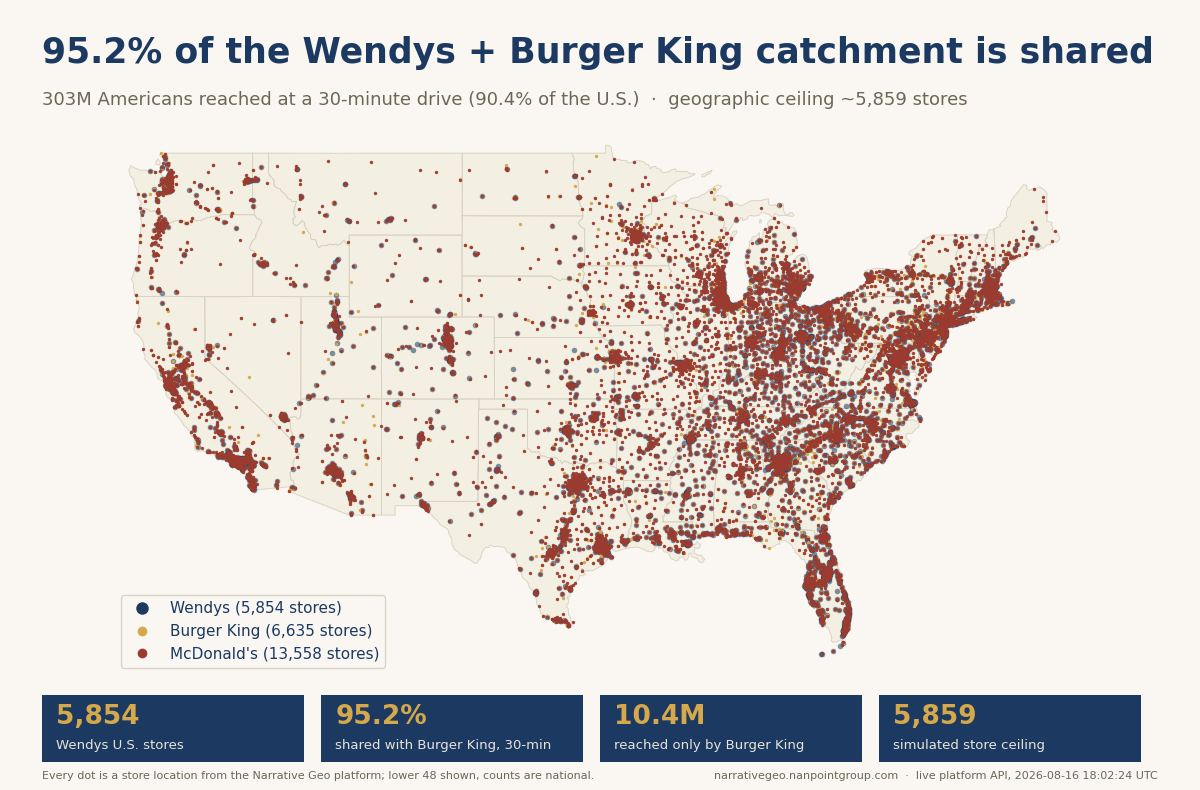
Nelson Peltz's Trian is reported to be assembling an investor group to take Wendy's private, with a bid expected in the coming weeks. Flynn Group, a longtime Wendy's franchisee, and BlueFive Capital have been named as possible members of the consortium. The stock jumped as much as 15% on the report on August 12 and was halted for volatility. The company said it would review any Trian proposal consistent with its fiduciary duties.
Earlier this month, Burger King was reported to have overtaken Wendy's as the second-largest US burger chain. Burger King's domestic same-store sales were reported up 8.5% in the second quarter. Wendy's US comps were reported down about 7%, a sixth straight quarterly decline.
That is the reporting. What follows is our own measurement of the physical network, because a take-private bid is in the end a bid for real estate and the people who live near it.
What the footprint reaches
By our count Wendy's operates 5,854 US stores. Put a 30-minute drive around each one, and the union of those trade areas covers 90.37% of the US population. Average household income inside the footprint is $94,536. Our per-store figure is 51,717 people covered per store.
Burger King operates 6,635 stores and reaches 92.05%. McDonald's operates 13,558 and reaches 95.61%.
So nobody is winning on reach. Three national chains sit on top of roughly the same country. The question worth asking is how much of that country each one holds alone.
Where the chains stop being interchangeable
At a 30-minute drive, 95.16% of the combined Wendy's and Burger King population sits inside both trade areas. The ground Wendy's holds and Burger King does not comes to 4,753,030 people. Against McDonald's it is 390,509 people.
Read that as a bidder. Almost none of the network is defensible on the grounds that no one else can reach the customer. Something else has to do that work. The site itself, the drive-thru, the price, the operator.
Drive time changes the picture, though not the conclusion. Tighten to five minutes and 59.4% of the population Wendy's covers still has a Burger King that close. 85.9% has a McDonald's. At ten minutes those become 88.4% and 98.4%. Whatever exclusivity exists lives in the first few minutes of a drive, and it is thinner against McDonald's than against Burger King at every distance we measured.
Closures are a trade-area question
Wendy's has been reported to be closing between 5% and 6% of its US restaurants in the first half of this year, described as a system optimization aimed at consistently underperforming stores. The count is not the interesting part. Which trade areas is.
The store-level distribution shows how uneven the network is. The median Wendy's store has 506,951 people inside its 30-minute drive. The store at the tenth percentile has 56,814. And 1,933 stores sit in the small-population band our model tracks. Those are the places where a closure decision is also a coverage decision, because there is no second Wendy's nearby to absorb the traffic.
Going the other way, there is very little left to build. Our saturation model puts the US network at 99.9% of its ceiling, with 5 incremental sites worth adding. Those five candidate markets hold 121,439 people between them. The largest is Ridgecrest, California, at 20,800 people. That is not a growth story anyone underwrites. A buyer here is buying an installed base and the option to run it better.
The exhibit pack behind this piece is available if you want the underlying maps and tables. It is citation-ready. The only thing I ask is attribution.