Nelson Peltz's Trian Fund Management is reportedly assembling an investor group to take Wendy's private, with a bid expected in the coming weeks. Flynn Group, a longtime franchisee, and BlueFive Capital may join. The stock jumped as much as 15 percent on August 12 on the report and was halted for volatility. The company said it would review any Trian proposal consistent with its fiduciary duties. Separately, CNBC reported Burger King has overtaken Wendy's as the second-largest US burger chain.
We published our footprint work on Wendys before this print. The company has now reported. I am not going to relitigate the quarter, and I do not have the numbers in front of me to try. What I have is the map, which does not change on a Tuesday evening.
So here is what it said in advance.
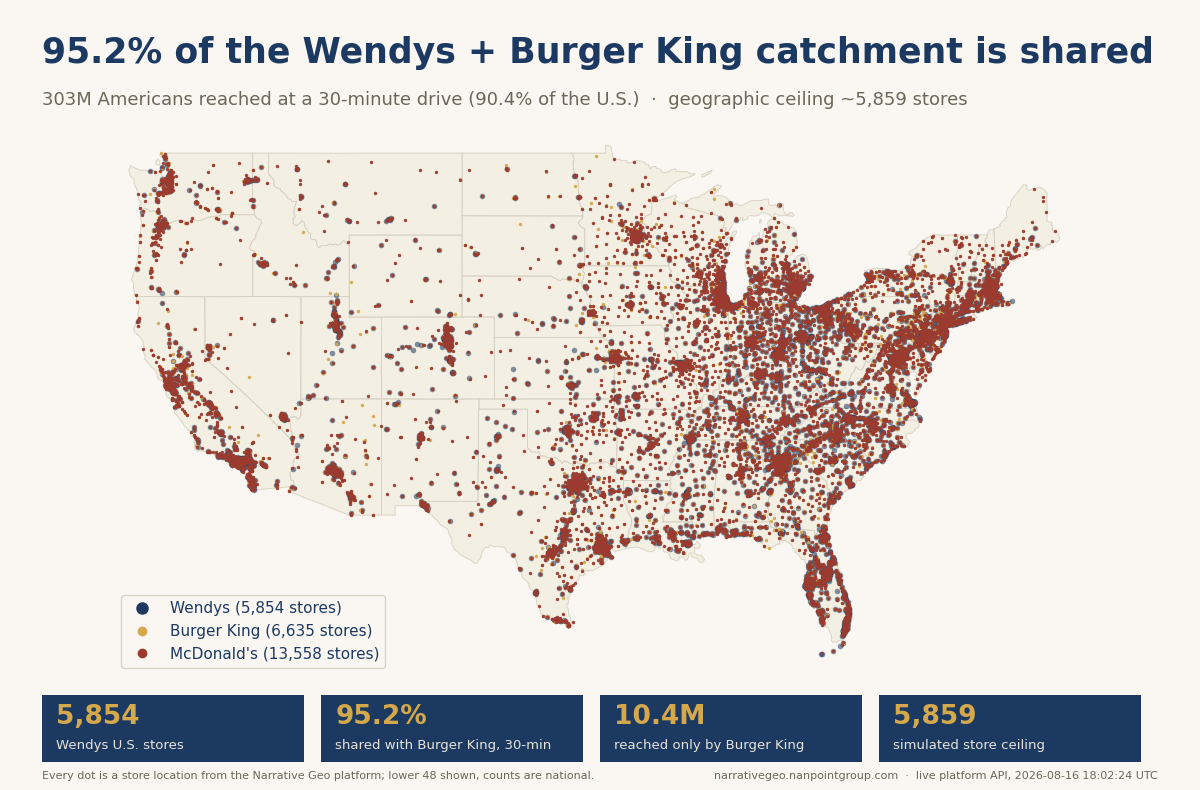
Wendys operates 5,854 US stores. Inside a 30-minute drive of those stores live 302,753,362 people, 90.37 percent of the country. Average household income in that reach is $94,536. Median age is 38.5. That is a national footprint by any definition.
Burger King reaches 308,390,721 people, 92.05 percent of the US. McDonald's reaches 320,301,656 across 13,558 stores, 95.61 percent. On store count, Wendys sits at 0.88 of Burger King and 0.43 of McDonald's.
The overlap is the interesting part. At 30 minutes, 95.16 percent of the combined Wendys and Burger King population can reach both. That number is close to meaningless. Nobody drives 30 minutes for a burger. Tighten the ring and the picture separates. At 15 minutes, overlap is 88.9 percent. At 10 minutes, 77.9 percent. At five minutes, 38.4 percent. Only 59.4 percent of Wendys reach has a Burger King within five minutes.
That five-minute band is where the two chains fight. It is also where a buyer's arithmetic lives. Everything outside it is atlas trivia.
Exclusivity is thin. Just 4,753,030 people can reach a Wendys at 30 minutes and no Burger King. Against McDonald's it is 390,509. There is almost no part of the Wendys map that only Wendys serves.
On closures, reporting says Wendy's is shutting between 5 and 6 percent of US restaurants in the first half of 2026 as system optimization. Our distribution shows where the pressure would sit. Median store trade area holds 506,951 people. The tenth percentile holds 56,814. And 1,933 stores sit under 250,000 people. That is the thin end of the book. The ninetieth percentile is 2,004,765.
Growth room is close to gone. Our saturation model puts the ceiling at 5,859 stores, five above the current count, 99.9 percent of ceiling. The whitespace list runs to five candidates: Ridgecrest, Hilo, Fond Du Lac, Walla Walla, Lake Havasu City. Total population across all five is 121,439. That is not a growth plan. It is a rounding error.
Hold all of that against what you heard on the call. If the story was closures, the question is which end of the distribution. If it was competition, test the five-minute number, not the thirty.
Next on the calendar is Dick's Sporting Goods on August 25, then Kohl's on August 26 and Dollar Tree on August 27. We will have the footprint work out before each of them.