Starboard Value disclosed a new stake in Shake Shack on August 5, 2026, reported to be worth several hundred million dollars and likely the largest active position in the stock. The shares gained about 8.6% to $71.90 on the news. The reported thesis is that Shake Shack should layer US franchising on top of company-operated growth, cutting the capital required per unit and lifting returns. Reporting puts the current base at roughly 460 US restaurants of 710 or more worldwide, against a stated long-term target of 1,500 domestic locations.
That target is the interesting part. It is a number about geography. So we mapped the geography.
What the current footprint actually covers
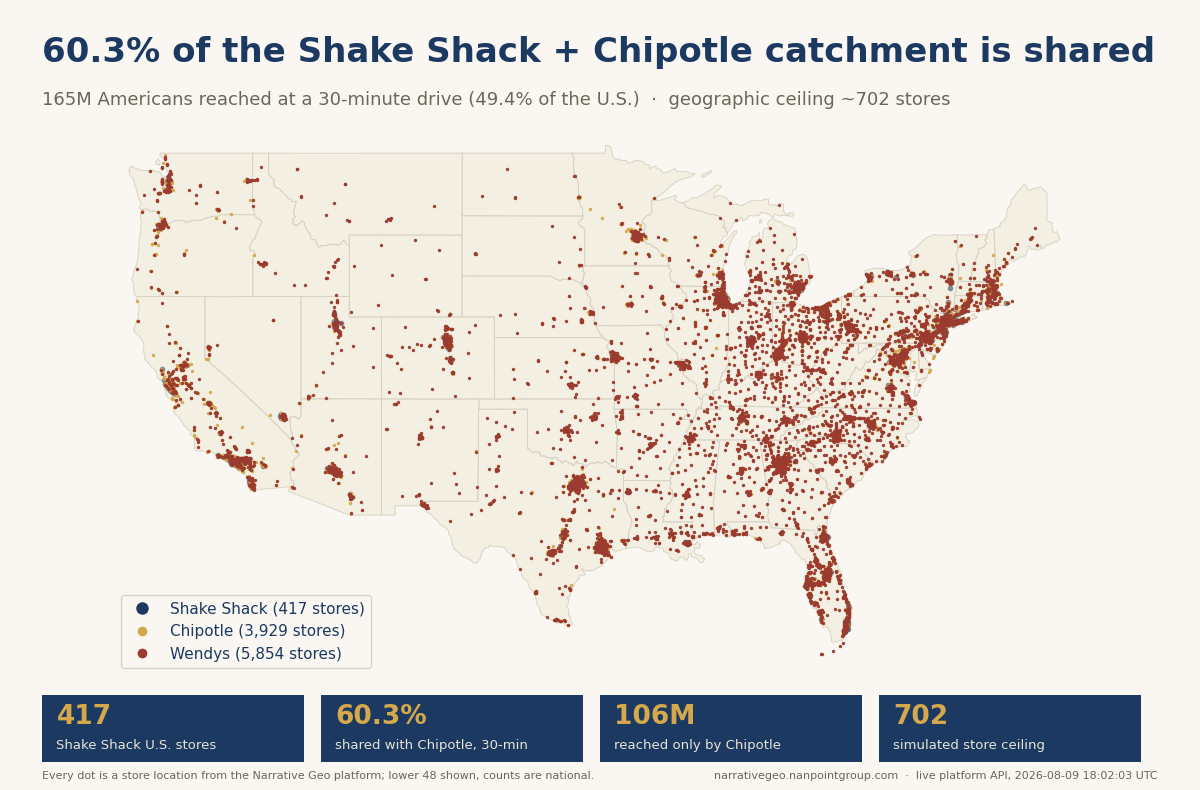
We drew a 30 minute drive time around every one of the 417 US Shake Shacks in our store file and measured what falls inside. The footprint reaches 165,443,613 people, 49.38% of a US population of 335,025,774. Average household income inside it is $105,554. Median age is 38.1. Working age population inside the footprint is 103,593,209, and 24.7% hold a bachelor's degree with a further 16.9% at master's or above. Daytime population is 173,017,719 against 73,096,123 jobs. This is an urban, high-income, high-daytime-density footprint, and it was clearly built that way.
The store-level distribution says the same thing more bluntly. The median store has 1,794,083 people inside its 30 minute ring. The tenth percentile is 721,133. The ninetieth is 6,291,941 and the largest ring holds 10,206,251. Only 4 stores sit in rings under 250,000 people. Population per store across the chain is 396,747.
For context, that is roughly a Chipotle-shaped market at a fraction of Chipotle's density. Chipotle covers 269,795,939 people on 3,929 stores, 80.53% of the country. Wendy's covers 302,753,362 on 5,854 stores, 90.37%. Shake Shack's store ratio against Chipotle is 0.11 and against Wendy's 0.07.
Where the overlap sits, and where it does not
At 30 minutes, 98.9% of the population Shake Shack reaches is also reached by Chipotle. Against Wendy's it is 99.9%. Shake Shack has almost no exclusive geography at that radius: 1,773,255 people versus Chipotle, and 112,815 versus Wendy's. That is not a criticism. It means Shake Shack has put its restaurants in markets that are already proven to support fast casual, which is the low-risk half of a growth story.
Tighten the drive time and the two chains separate. At five minutes, 88.3% of Shake Shack's population is inside a Chipotle ring but only 15.2% of Chipotle's is inside a Shake Shack ring. Union overlap at five minutes is 14.9%. At ten minutes it is 27.1%, at fifteen 41.5%. Against Wendy's, five minute union overlap is 7.6% and the share of Shake Shack's own population covered drops to 49.1%. So they share metros and they do not share corners. The competitive question is trade-area level, not map level.
What the build model returns
We run a saturation model that adds stores into unbuilt trade areas until the next one stops buying meaningful incremental population. Against a 30% threshold it evaluates a candidate pool of 1,141 trade areas, of which 580 fall below the threshold, and stops at 702 US stores. That implies 285 incremental units from here. The current base is 59.4% of that ceiling.
That is a genuine runway. It is also visibly not the 1,500 in the reported target, at this drive time and this threshold. The gap is worth arguing about rather than assuming away. A franchised unit can be smaller, cheaper and viable in a thinner trade area than a company-operated one, which is precisely the argument being made. If franchising works, the ceiling moves. The honest way to hold the target is as a claim that the trade area definition changes, not as a claim that there are 1,500 markets like today's.
The whitespace screen returns 60 candidate markets holding 1,472,444 people combined. The top-scoring is Riverview in the Tampa-St. Petersburg-Clearwater metro, population 27,422, average income $106,931, score 0.863. Simpsonville outside Greenville scores the same. Then three Atlanta suburbs in a row: Dacula, Grayson and Snellville. Port Orchard, West Melbourne and Boise round out the top of the list. Suburban, affluent, adjacent to metros the chain already serves. Exactly the kind of site a franchisee takes and a company-operated build team passes on.
The exhibit pack behind this piece is available if you want the maps and the underlying tables.